
The costs and margin freelancers forget when setting a rate
When freelancers work out a rate, the income goal gets all the attention. Costs and margin quietly decide whether that goal is actually met.
What counts as a business cost
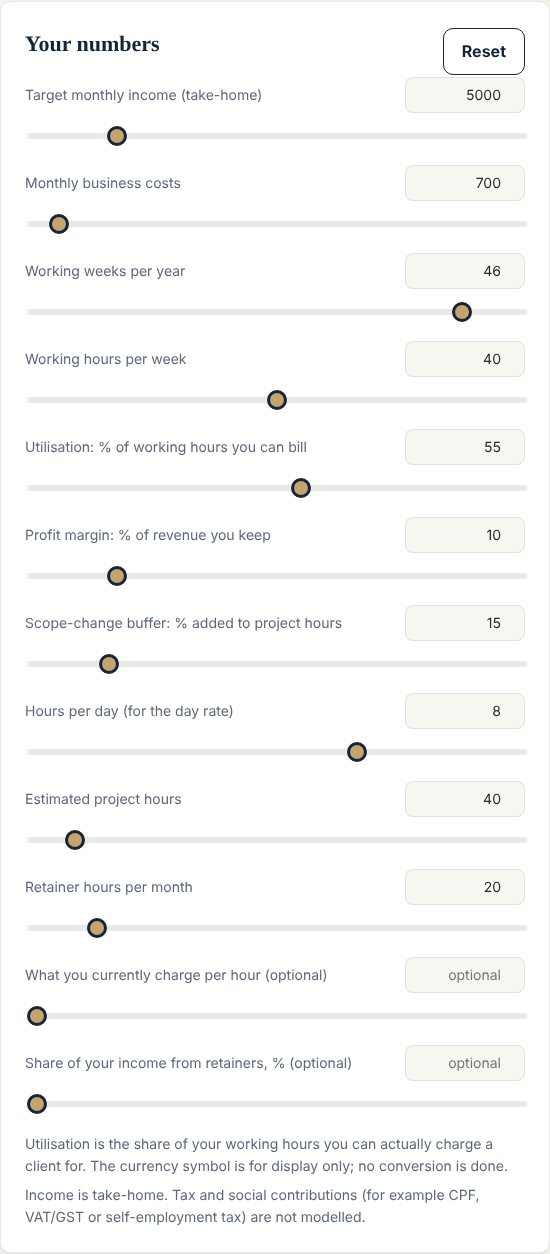
RateFlow asks for your monthly business costs. Think beyond the obvious: software subscriptions, equipment and its eventual replacement, insurance, a desk or co-working space, accounting, training, marketing and bank fees. List them for a year and divide by twelve, so occasional bills are not forgotten.
What a cost does to your rate
Costs are added to your income goal before dividing by your billable hours. With the default numbers (S$5,000 take-home a month, 46 weeks, 40 hours a week, 55% billable, 10% margin), S$700 of monthly costs gives a minimum of about S$75.10 an hour. Raise those costs to S$1,000 and the minimum becomes about S$79.05, an extra S$3.95 on every billable hour.
What the margin is for
The profit margin is the share of revenue you keep after costs and your own pay. It is your cushion for slow months and the money you can put back into the business. With the same defaults, raising the margin from 10% to 20% lifts the minimum from about S$75.10 to about S$84.49.
The project buffer
For a project price, RateFlow multiplies your hours by your minimum rate and then adds a buffer, 15% by default, because projects rarely take exactly as long as planned. Change it if your work is more or less predictable.
Take-home versus tax
Income in RateFlow is take-home. Tax and social contributions are not modelled, so add your own if you need a before-tax figure.
Try different costs and margins in the free RateFlow calculator. If you have not yet worked out your minimum, start with how to work out your minimum freelance rate.