
How to work out your minimum freelance rate
A common way to set a rate is to look at what others charge. A more useful starting point is the least you can charge and still reach your own income goal.
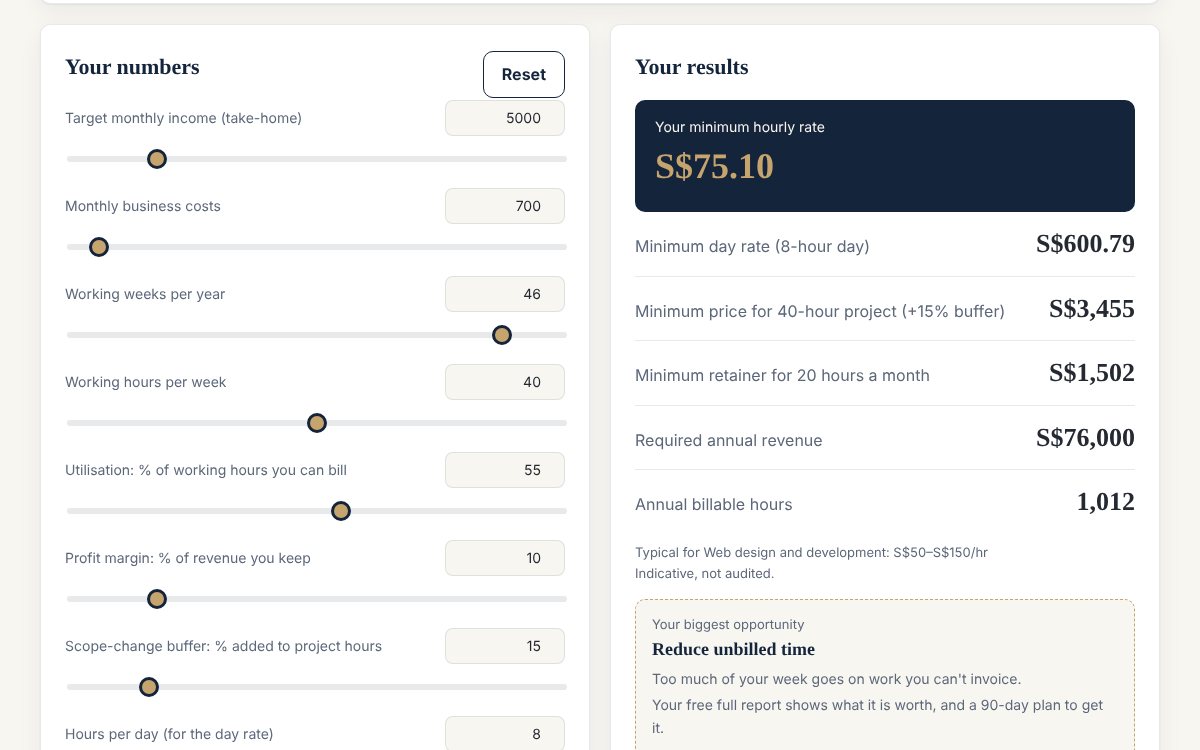
Start with five numbers
Your target monthly take-home income, your monthly business costs, the weeks you work in a year, the hours you work in a week, and the share of those hours you can actually bill. Add the profit margin you want to keep on top.
The steps
- Billable hours. Hours per week × billable share = billable hours per week. Multiply by your working weeks for the year.
- Required revenue. (Monthly income × 12 + monthly costs × 12) ÷ (1 − profit margin).
- Minimum hourly rate. Required revenue ÷ annual billable hours.
With S$5,000 a month of take-home income, S$700 of costs, 46 working weeks, 40 hours a week, 55% billable and a 10% margin, you need S$76,000 a year across about 1,012 billable hours. That is a minimum of about S$75 an hour.
Why not just divide by 40 hours?
Because nobody bills every hour. Time spent on admin, finding clients and quoting is real work you cannot invoice, so your rate has to cover it. This is why the billable share matters so much, and we look at it in why billable hours matter more than your hourly rate.
Income in RateFlow is take-home, and tax and social contributions are not modelled, so keep your own tax rules in mind. Try the numbers yourself in the free RateFlow calculator, or read about it on the RateFlow page.