
Offshore, in-house or large vendor: how your delivery model changes an IT budget
Two teams can build the same app and quote very different numbers. The work is the same, but who does it, and how experienced they are, is not.
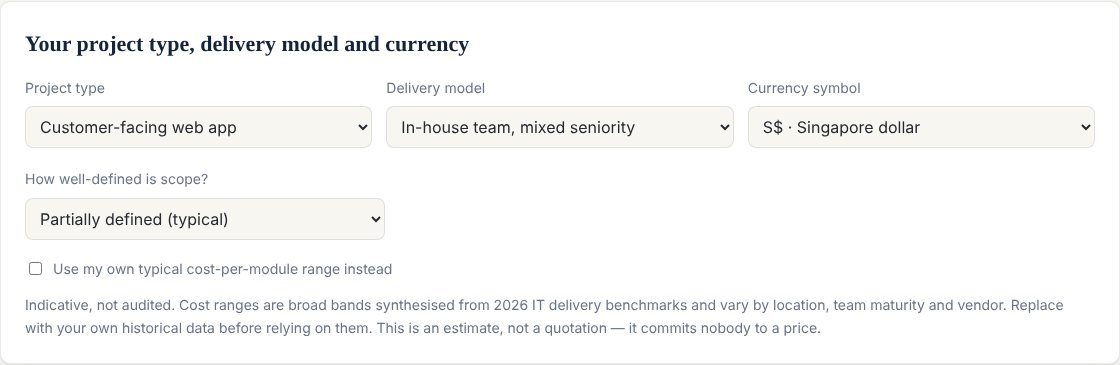
One project, six models
ScopeFlow starts from a typical cost per module for your project type and scales it by the delivery model. For a 12-module customer-facing web app with a team of six, the suggested budget changes like this:
| Delivery model | Baseline | Suggested range | Midpoint |
|---|---|---|---|
| Offshore or nearshore outsourced | 0.6× | S$36,000–S$72,000 | S$54,000 |
| In-house, mostly junior | 0.8× | S$48,000–S$96,000 | S$72,000 |
| In-house, mixed seniority | 1.0× | S$60,000–S$120,000 | S$90,000 |
| In-house, senior-heavy | 1.3× | S$78,000–S$156,000 | S$117,000 |
| Boutique consultancy | 1.6× | S$96,000–S$192,000 | S$144,000 |
| Enterprise or large vendor | 2.3× | S$138,000–S$276,000 | S$207,000 |
A lower baseline is not a promise of a cheaper outcome. Coordination, time zones, quality and rework are for you to weigh. What the table shows is that you should always choose the model you will really use, not the cheapest one.
Team size sets a floor
ScopeFlow also applies a minimum budget that rises with team size, before the delivery model is applied: S$8,000 for fewer than three people, S$20,000 for three to five, S$50,000 for six to eleven, and more beyond that. So a small project with a team of six is still suggested at S$50,000–S$90,000, because a team of that size costs a lot to keep busy. If your scope is small, try a smaller team.
These are broad, indicative benchmarks and not a quotation. Test your own setup in the free ScopeFlow calculator, and see how to estimate an IT project budget for the full method.