
Scope buffer, discount and deposit: how they change your quote
Three small percentages change what a quote is really worth to you: the buffer you add for changes, the discount you offer, and the deposit you ask for up front. Order matters, so here is how QuoteFlow works them out.
The order of the sums
- Labour = hours × rate for each line.
- Scope buffer = labour × buffer %. It covers small changes.
- Discount = (labour + buffer) × discount %.
- Net labour = labour + buffer − discount.
- Subtotal = net labour + fixed-fee and pass-through items, which get no buffer and no discount.
- Tax = subtotal × tax rate, and total = subtotal + tax.
- Deposit = total × deposit %, and the balance is what is left.
A worked example
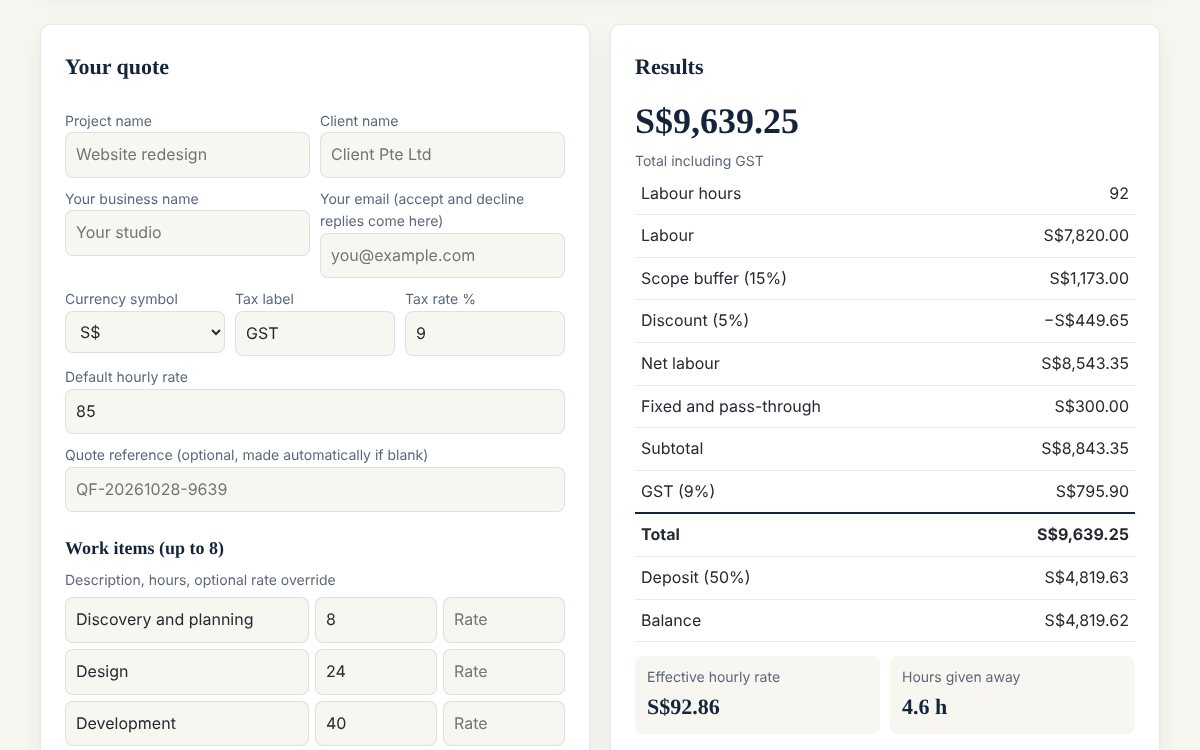
Take 92 hours at S$85, which is S$7,820 of labour. A 15% buffer adds S$1,173, and a 5% discount takes off S$449.65, so net labour is S$8,543.35. Add S$300 of fixed costs for a subtotal of S$8,843.35, then 9% GST of S$795.90 for a total of S$9,639.25. A 50% deposit is about S$4,820.
Your effective hourly rate is net labour divided by hours: S$8,543.35 ÷ 92 is about S$92.86. The buffer more than covers the discount, so you earn more per hour than your S$85 headline rate. The discount itself gives away about 4.6 hours of work.
Three warning signs
QuoteFlow flags a buffer under 10% (small changes may come out of your margin), a discount over 15% (check the hours you are giving away) and a deposit under 30% (you carry most of the cash risk).
Try your own quote in the free QuoteFlow calculator. To write the quote itself, read how to write a quote clients say yes to.