
How to estimate an IT project budget before you commit to a number
The most expensive moment in a project is often the first one, when someone names a number before the scope is clear. A range gives you somewhere safer to start from.
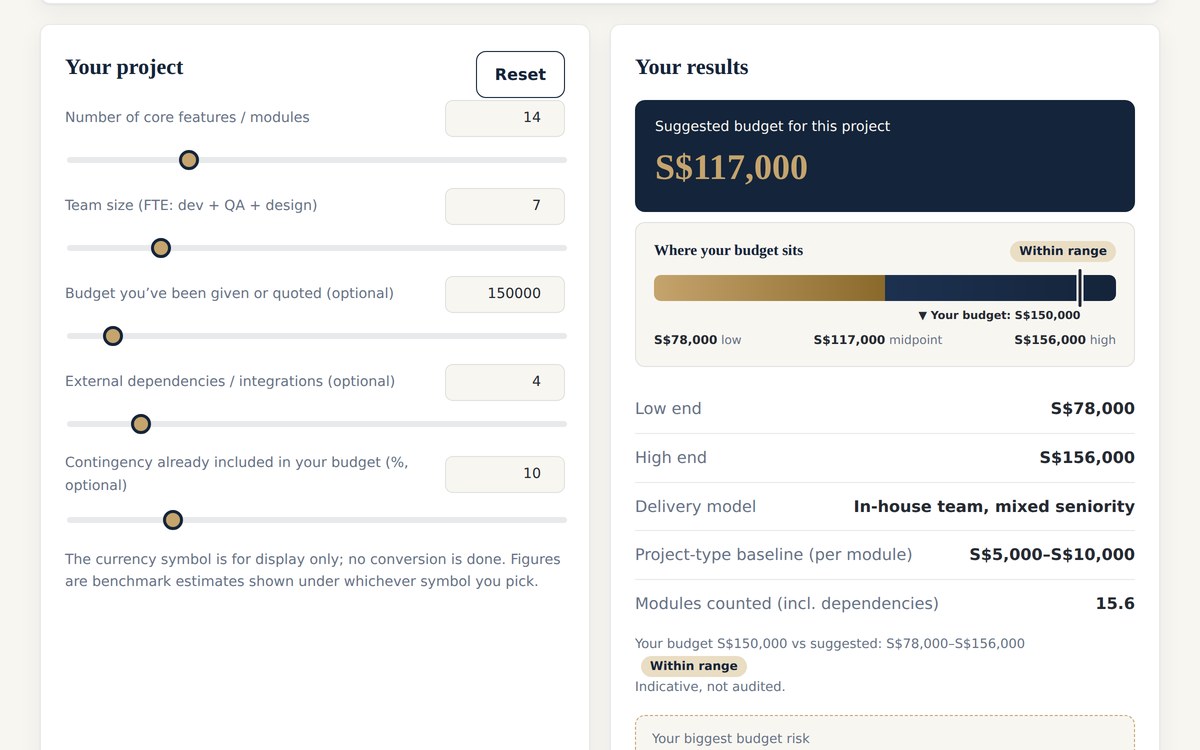
What goes in
ScopeFlow starts from the kind of project (ten common types, from internal tools and integrations to mobile apps, AI features and legacy modernisation) and how the work is resourced (six delivery models, from offshore outsourced to in-house teams at different seniority levels, a boutique consultancy or a large enterprise vendor). Then you add the number of core modules or features, and your team size.
How the range is built
Each project type has a typical cost per module, and the delivery model scales it. A customer-facing web app is benchmarked at S$5,000–S$10,000 per module for an in-house team of mixed seniority. For 12 modules that gives a range of S$60,000 to S$120,000, with a midpoint of S$90,000.
How well-defined is the scope?
You also say how settled your requirements are. If they are locked, the range narrows around the same midpoint. If you are at an early stage and not yet scoped, it widens by half again. The midpoint does not move; the honesty about uncertainty does.
Use it as a sanity check
These are broad, indicative benchmarks and not a quote, so replace them with your own history when you have it. Enter the budget you have been given and ScopeFlow shows where it sits in the range.
Try it with the free ScopeFlow calculator, or read more on the ScopeFlow page. Next, see how to spot IT project budget risks early.