
Is your website conversion rate good? How to compare with your industry
A conversion rate on its own tells you very little. Is 3% good? It depends on your industry, and on which step of the journey you are measuring.
Two rates, two questions
The visitor-to-lead rate asks how well your website turns visitors into enquiries. The lead-to-customer rate asks how well your follow-up turns enquiries into customers. A business can be strong on one and weak on the other, and the fix is different for each.
Typical ranges
LeadFlow compares you with broad, indicative ranges for each industry. For example:
- Professional services (B2B): 2–5% of visitors become leads, and 15–30% of leads become customers.
- Clinics, dental and wellness: 3–8% and 30–50%.
- Home services and renovation: 4–10% and 20–40%.
- Education, tuition and coaching: 2–6% and 10–25%.
- Software and SaaS: 1–5% and 10–25%.
- Real estate: 1–4% and 2–8%.
These are rough bands, not audited statistics. Use them as a guide, and replace them with your own history as it builds up.
Finding the change worth the most
LeadFlow tests four realistic changes: moving each rate up to the middle of the typical range for your industry (or up a step if you are already there), a 10% higher average sale, and 10% more visitors. The one that adds the most revenue is your biggest opportunity.
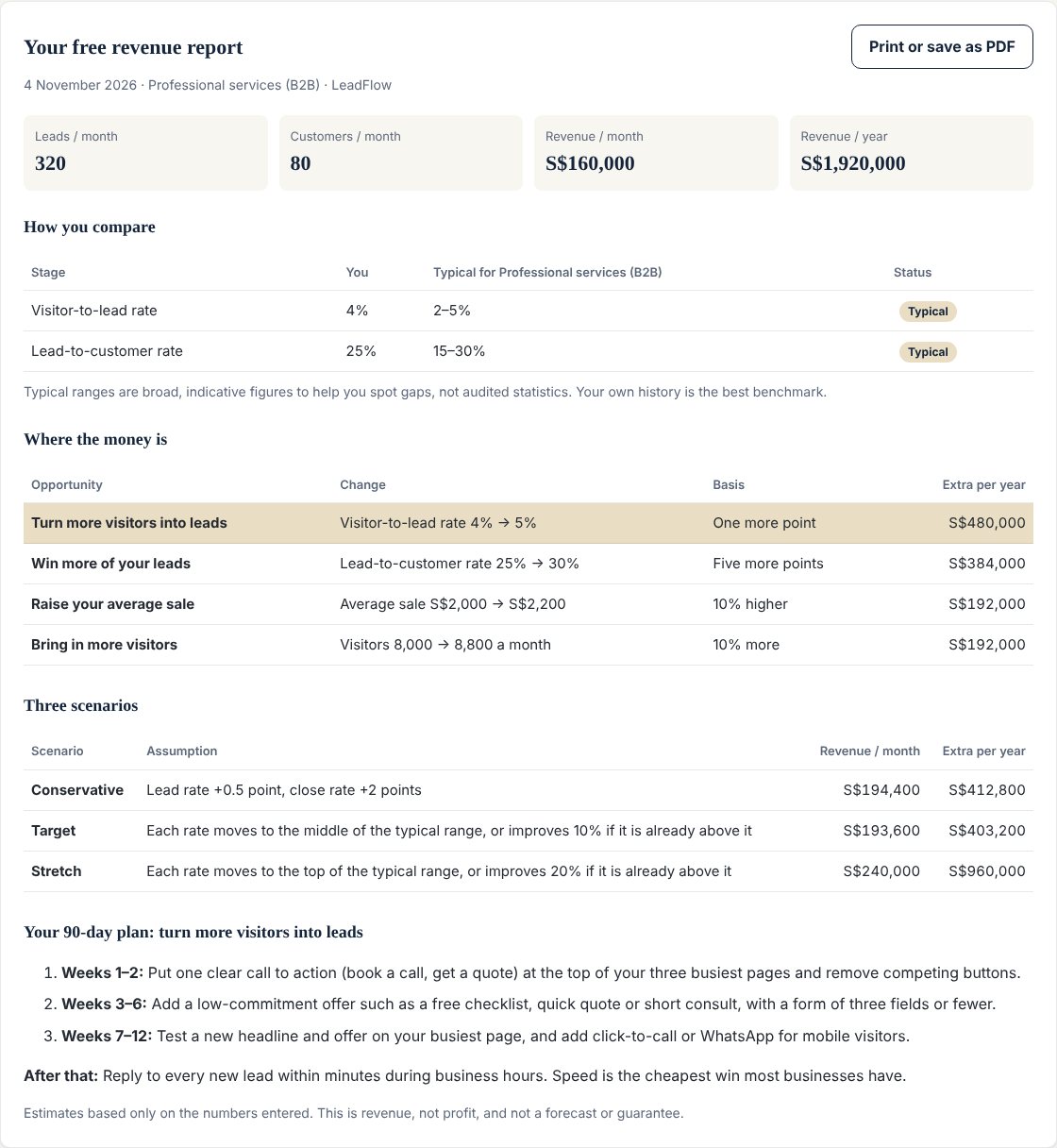
Open the free LeadFlow calculator, pick your industry and enter your numbers to see where you stand. New to the sums? Start with how to calculate revenue from your leads.