
Hourly rate, day rate, project price or retainer: which should you quote?
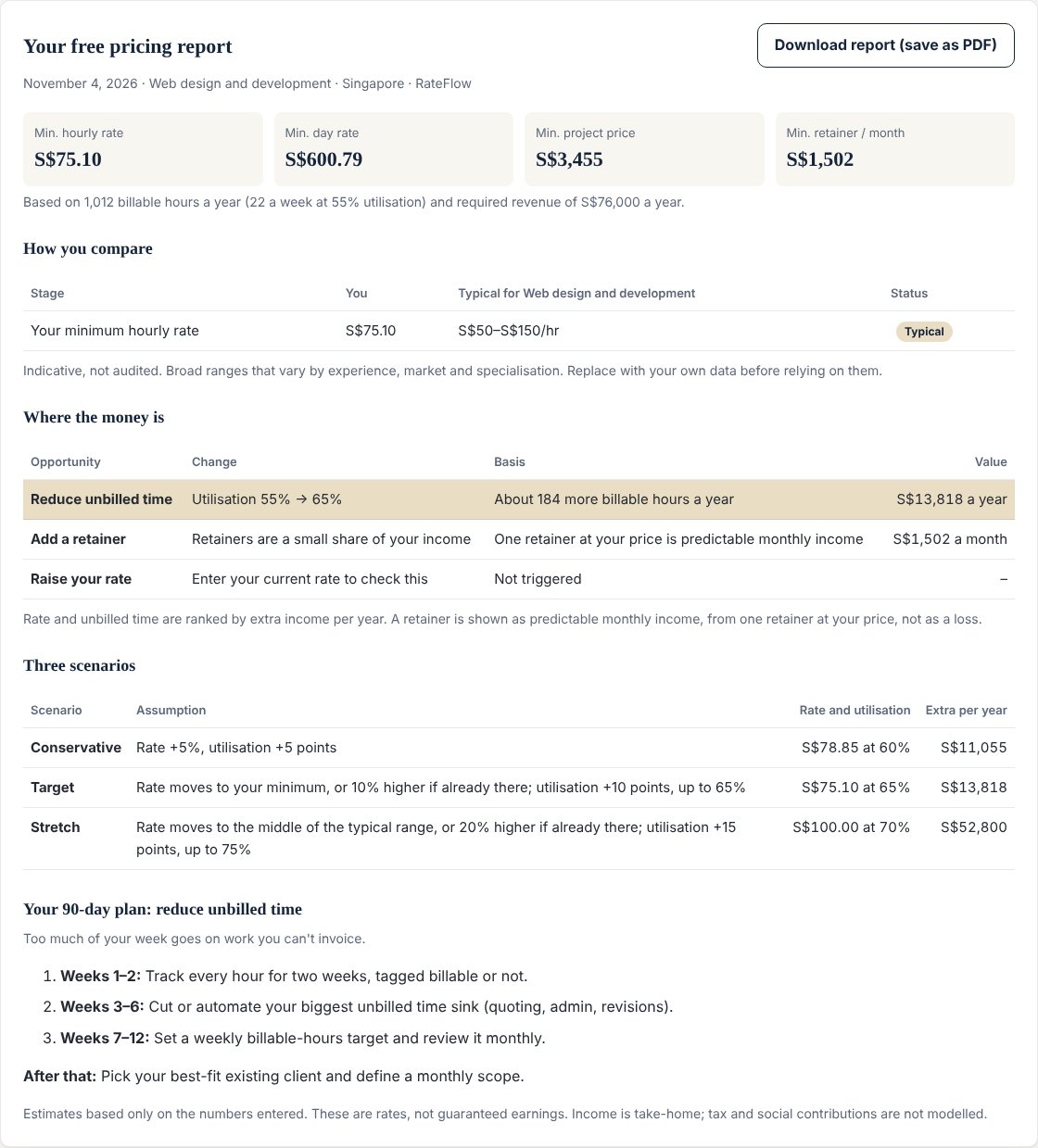
Once you know your minimum hourly rate, the other pricing models follow from it. They are the same number, packaged differently for different kinds of work.
How each is built
- Hourly rate. Your minimum rate, found from your income goal, costs and billable hours.
- Day rate. Your hourly rate × the hours in your working day. At about S$75 an hour and an 8-hour day, that is roughly S$600.
- Project price. Your hourly rate × the hours you expect × a buffer for things that take longer. For a 40-hour project with a 15% buffer, that is about S$3,450.
- Retainer. Your hourly rate × the hours you reserve each month. For 20 hours a month, about S$1,500.
When each one fits
An hourly rate suits small or open-ended tasks. A day rate suits workshops, on-site days and short engagements. A project price suits work with a clear end, and it rewards you for being efficient. A retainer suits ongoing work and makes your income more predictable.
Treat the result as a floor
These figures are the lowest prices that still hit your target. They are not what the market will pay, so quote above them when you can. RateFlow also shows a service-type comparison so you can see where your minimum sits against typical ranges, which are broad and indicative.
Work out all four in the free RateFlow calculator, then turn them into a priced quote with how to write a quote clients say yes to.