
How to quote a project without underpricing it
Most quotes lose money before the project starts. They copy the last quote, round the hours down, and forget the buffer, tax and deposit. A good quote is built from small, honest steps, and it ends with a check: what hourly rate does this quote actually pay you?
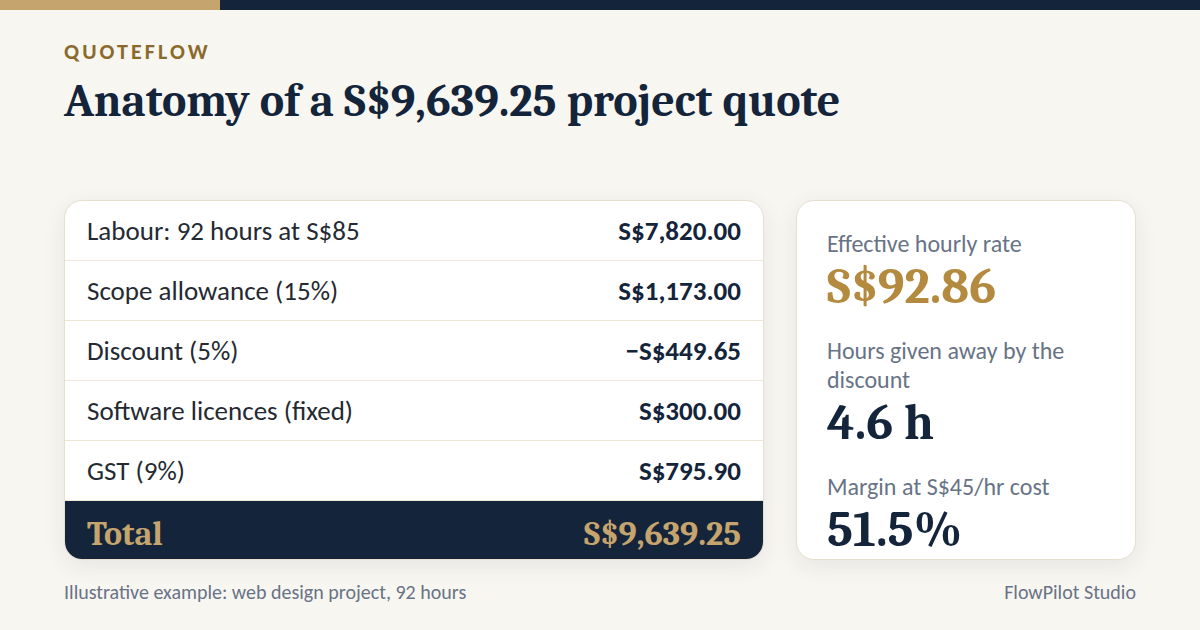
Build it in seven steps
- List the work in phases. For example discovery, design, development, content setup, and launch.
- Estimate hours for each phase. In the example: 8, 24, 40, 12 and 8, which is 92 hours.
- Multiply by your rate. At S$85 an hour, labour is S$7,820.
- Add a scope buffer. 15% adds S$1,173 for the small changes every project has.
- Decide the discount deliberately. A 5% discount takes off S$449.65. Net labour is S$8,543.35.
- Add fixed costs. S$300 of software licences goes on without buffer or discount, then 9% GST, giving a total of S$9,639.25.
- Set the deposit. A 50% deposit is S$4,819.63 on acceptance.
The check that matters
Divide net labour by the hours: S$8,543.35 ÷ 92 is S$92.86 an hour. Compare it with your minimum rate. If it is below, change the quote before you send it, not after the project overruns. The discount is worth a look too: here it equals 4.6 hours of free work.
Creative ways to use your quote
- Show the scope allowance as its own line. Clients see that changes are expected and priced, which makes later change requests easier to discuss.
- Use hours given away when a client pushes back. “This quote already includes about 4.6 hours at no charge” is concrete, and it moves the conversation to scope instead of price.
- Offer scope options. If the budget is tight, offer a smaller first phase rather than a deeper discount.
- Link it to your rate. Work out your minimum rate in RateFlow first, then use it as the floor for every quote.
Pro (Business licence), coming soon: Start from templates for ten service types, offer Good, Better and Best packages, and save quotes to reuse. Join the Pro waitlist.
Try it with your own numbers
Build a quote in the free QuoteFlow calculator, and not sure of your rate? Start with RateFlow.
Numbers are examples in Singapore dollars with a 9% GST rate; set your own tax. Estimates only, not financial, tax or legal advice.