
How many hours can you really bill? The utilisation maths
If you work 40 hours a week, you probably cannot bill 40. Quoting, admin, learning, bookkeeping and chasing payments all need time. The share of your working hours that you can actually invoice is your utilisation, and it moves your minimum rate more than almost any other number.
What it does to your rate
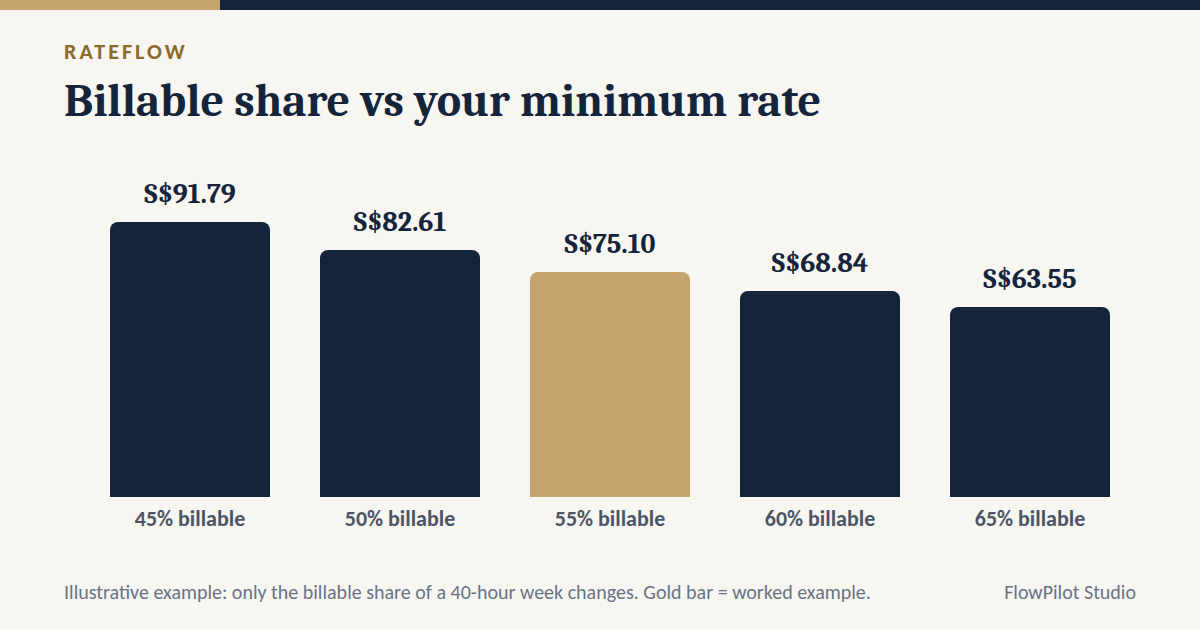
Keep the same income goal, costs and margin, and change only the billable share of a 40-hour week over 46 weeks. Your required revenue stays at S$76,000.
- 45% billable (18 hours): S$91.79 an hour
- 50% billable (20 hours): S$82.61 an hour
- 55% billable (22 hours): S$75.10 an hour
- 60% billable (24 hours): S$68.84 an hour
- 65% billable (26 hours): S$63.55 an hour
Overestimating your billable time makes your rate too low, and the shortfall comes straight out of your income.
How to measure yours
- Track every hour for two weeks and tag each one billable or not.
- Divide billable hours by total working hours.
- Use that figure in the calculator, not the number you hope for.
A caution: billing more than about 30 hours a week, or over 75% of your time, is rarely sustainable for long. The free tool flags it when you enter figures that high.
Creative ways to raise it
- Batch your admin. Put invoicing and email into fixed slots so they stop interrupting billable work.
- Template the quoting. Quotes you write from scratch are a hidden cost. A reusable quote layout shortens them.
- Price revisions in. Include a set number of revision rounds in the quote, so extra rounds are billable.
- Review your clients. A client who takes twice the admin time of others may be costing you more than the rate suggests.
Pro (Business licence), coming soon: See profit per client, comparing the rate you charged with your true cost per hour, so you can spot which clients pull your utilisation down. Join the Pro waitlist.
Try it with your own numbers
Enter your own utilisation in the free RateFlow calculator and watch your minimum rate move. Then price your next project in QuoteFlow.
Numbers in this article are examples in Singapore dollars; use your own. Income is take-home, and tax and social contributions are not included. Estimates only, not financial advice.